- Details
- Written by: admin
- Category: Article
- Hits: 7395
March 30 to April 1, 2012 Düsseldorf (Germany)
Article von by Humdinger - 06. April 2012 - Haiku OS
As this was one of the smallest BeGeistert meetings, this report will be quite short as well...
I arrived at the airport on Saturday morning at about 9:15 and made it to the nice location at Düsseldorf's youth hostel at 10 o'clock. After weeks with temperatures up to 20 °C, the good weather took a day off and I made the 10 minute walk from the station "Luegplatz" to the hostel in a very fine drizzle and shivering 10 °C...
Opening the door to our conference room I was greeted by 7/10th of our full number this time: the French delegation with Olivier, Jérôme and Adrien; Mark with his trusty 15 year old Toshiba laptop running BeOS and Axel who had to discover that his notebook isn't of that same sturdy quality. Not only did his mouse die (which strangely kept working for a while, but only when used in the middle of his freaky keyboard), but apparently Ubuntu forgot to turn on the fans, resulting in an overheat emergency shutdown...
Andre, treasurer of the Haiku Support Association (HSA) that sponsors and organizes BeGeistert, was also there after having missed the last few meetings. Unfortunately he had to leave already shortly after lunch.
Just before lunch came the rest of the gang: Charlie sweating profusely after an adventurous bike ride including a chain malfunction, and Christian and Lorenz, the BeSly guys from Hamburg.
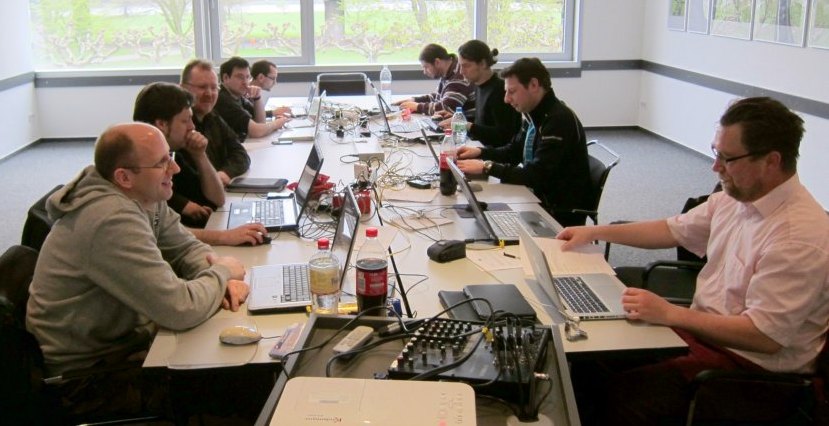
While last BeGeistert (024) saw quite a few talks and demonstrations (though a report of it all sadly failed, other than the videos on package management and the move to git), there was none of that this time. There's hope that with a usually higher number of participants, this will pick up again the next time.
Instead everyone was busy hacking away on their various projects and favorite bugs. In my case, I occasionally disturbed Axel with BFS related KDLs which I hope helped him with the accomplished fixes.
At the same time of BeGeistert 025 the first "Bugfix Weekend" was held in IRC/BeShare. I think it was pretty quiet in those channels, but the contributions that weekend show that not only the BG coders where busy. I just quickly asked around what the people at BeGeistert were working on mainly:
Olivier took a little break from his efforts on "OpenOffice for Kids" and spent most time on the
Freepascal port. Recent builds had some problems, especially concerning signal handling. Now a few more tests pass under Haiku.
Jérôme added missing parts for an ARM libroot and investigated how much of glibc is ARM-ready. Turns out it may need a new version, so a look at other options (uClibc, newlib, eglibc) could be worthwhile. He also fixed the es1370 audio driver build.
Adrien patched the USB mass storage driver to get copying files to certain MP3 players working properly. Next were some fixes for the game
Critical Mass and the build of the music editor Sawteeth under gcc4. Then he started work on integrating the
Game Music Emu (GME) library into APlayer to be able to play back Nintendo, Genesis, and some other chiptune file formats.
Axel was successfully hunting down bugs in the filesystem. One result of his work: checkfs is now able to repair errors in b+trees of indices. I suffered from those myself on various partitions which resulted in visits to the Kernel Debugging Land whenever I tried to build a Haiku image. All gone now, yay! Some of the tickets being affected by this and other bugs in that area were
#7951 and
Mark was busy improving the rendering engine of the
Themis browser. He got the loading of images to work, but currently only for local images (file:// protocol) using the translation kit. Here an old problem of his ancient BeOS R5 system reared its ugly head: crippled by patent issues, there was no GIF translator installed... He still has to do some more testing before committing to the Themis repository.
I did some small optical improvements for
UberTuber and tried to lend my meager C++ knowledge to Charlie, who was determined (and with Axel's help successful in the end) to put together a guide on creating "unit tests". Stuff for an upcoming article.
Christian and Lorenz were busily coding and discussing strategies for their
yabIDE (yabConcept Creator). All in yab of course, which recently saw a new version released, but could do with some more programmers to speed up its development.
One unusual thing did happen on Saturday evening: We got a visit from a professional photographer. He was to take high quality pictures from our flock of coders (and who else happens to resemble that on a short glance... :)). They're supposed to appear in a Haiku article in IEEE Spectrum Magazine that Ryan is preparing. Nice!
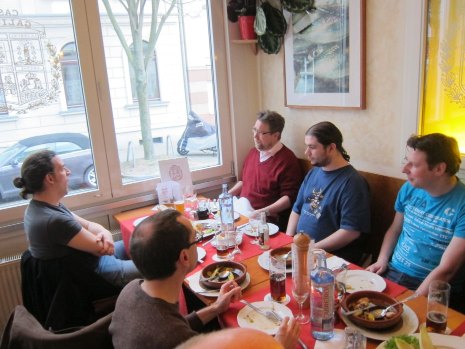
While he and his assistant set up the conference room, we all went to a nearby Spanish restaurant where we enjoyed very nice tapas, beer, wine and what else you'd expect in such a place.
 |
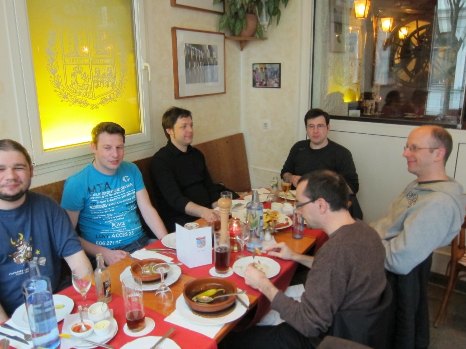 |
Two hours later we were back, sitting in the now sparsely illuminated conference room while the photographer fired away. Now I know how the other top models feel when they come on a set after stuffing themselves to the brim with Spanish delicatessen...
After the shoot was finished we had a look at the results on the photographer's notebook. Pretty stunning what a 80 megapixel camera can do in the hand of a professional.
Altogether we all had our fun on this BeGeistert even if we missed all our friends that couldn't make it. There definitely was less "buzz" in the air this time. To make the next one live up its usual glory, the date for the next BeGeistert is already fixed, so everyone can mark their calendar:
with
Code Sprint: 5.-9. November 2012
- Details
- Written by: admin
- Category: Article
- Hits: 6734
October 23 to 24, 2010 Düsseldorf (Germany)
Article by DaaT - 24 October 2010 - IsComputerOn
Hello everyone, I'm now back home so it's time to write the report about this past weekend's BeGeistert. As usual, BeGeistert's numbers tend to fluctuate and this time was no different. Last October's BeGeistert (I wasn't here in the Spring) for example was one of the busiest but this time we didn't make it into the 20's, it was close though. So was it fun?
Of course it was fun! BeGeistert always is. And it was an intercontinental BeGeistert as well. René (aka, a yak who is evil) came from the US for the coding week and left on Sunday morning. Even further than that, Christof and Clemens both came from New Zealand! Clemens was also here for the coding week prior to BeGeistert and Christof arrived on Friday morning. By Sunday he was still walking around like a zombie due to the jet lag (poor guy was 11 hours ahead of us, so basically having breakfast at 7pm). Two absences were most noted during the weekend, François Revol (mmu_man) didn't make it due to work and Charlie himself wasn't able to attend, for personal reasons (it's just not the same without you Charlie, you were missed by all).
Saturday was presentation day. We kicked off with a PDStore (Parsimonious Data Store) presentation by Christof (thanks for the PDF), an interesting project he's involved in the Auckland University. Next up was Clemens, this time with the SAT (Stack and Tile) and ALM (Auckland Layout Model) presentation. Earlier that morning we each did a few SAT tests on his laptop, to measure the time it would take us to perform certain tasks, with SAT and without SAT (in my case the results were much better with SAT, it was quite nice to use), and at the end we filled out a questionaire with our opinions, likes and dislikes about SAT.
The third and final presentation of the afternoon was Stephan's, and he showed us his work on a new Wonderbrush re-write that he's doing as well as his work on Clockwerk (an audio/video compositing app) that he's been working on for some months now, getting it back to shape and I must say it's quite a good looking shape.
The rest of the day was spent coding (they of course, not me) and after dinner at a nice restaurant, some more coding!
Sunday afternoon, in between all the coding and chats, we had a Haiku Status talk, with several developers participating:
- Alex (working on Tracker & layout code)
- Jerome (talking about Janito's GSoC 2010 project and his own work extending it)
- Olivier (working in porting applications, for example Lazarus, an open-source IDE which uses Qt to run on Haiku, and OpenOffice for Kids)
- Oliver (talked about the different version control systems he's been testing for future use by Haiku and his work on the Locale Kit)
- Axel (mainly talked about his network work)
- Stephan (talked about his media related work)
- Fredrik (talked about his current work on ACPI and IRQ)
We were also told that there's the possibility of making BeGeistert a "once-a-year" event while keeping the coding week to its actual schedule of twice a year. It does make sense, in the way that the money being spent in rooms, etc, would be spent in the coders and helping to move the project forward. It's still undecided of course, but talks are ongoing, let's wait and see what their decision is. If they do decide to make the change, I just hope they keep the Spring BeGeistert, the weather's much nicer :)
After the status talk people started leaving, like Alex, Stephan and Oliver and as the afternoon moved on, others followed. Later on it was my turn and after a pizza dinner with Axel, Clemens and Christof, I took a taxi to the airport for my flight back home. All in all it was a fun BeGeistert and whatever their decision will be about its schedule, I know I'll come back.
Thanks for reading this far, hope you enjoyed it.
- Details
- Written by: admin
- Category: Article
- Hits: 6554
April 10 to 11, 2010 Düsseldorf (Germany)
Article von by Humdinger - 15. April 2010 - Haiku OS
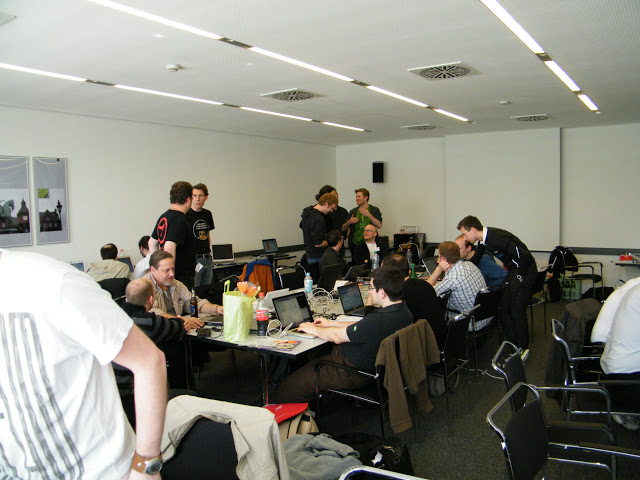
While the number of participants wasn't as staggeringly high as the last time in October after the R1/alpha1 was just out the door, about 30 people made it to the conference rooms of the youth hostel. Besides the usual suspects, a new developer, Sebastian, made his debut and fit right in.
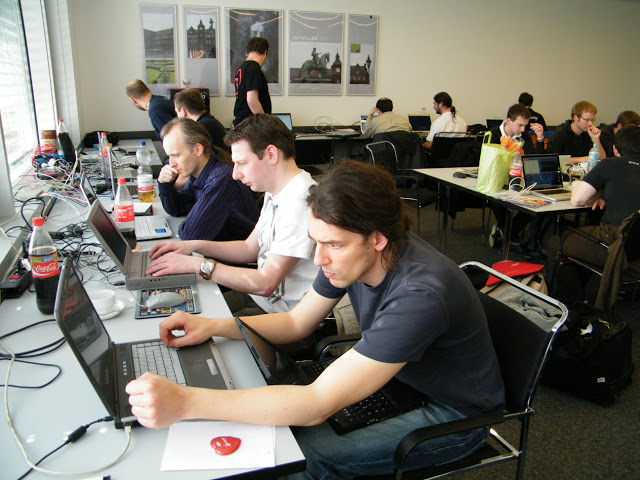
As usual people seized the opportunity to show their newest projects and the progress they've made. Everyone had their notebook set up and small groups started to form and dissolve and wander along to the next computer to discuss the little presentations. When Haiku showed some unusual behavior, say wander off to the kernel debugging land, a core developer could quickly be summoned to analyze and often fix the problem.
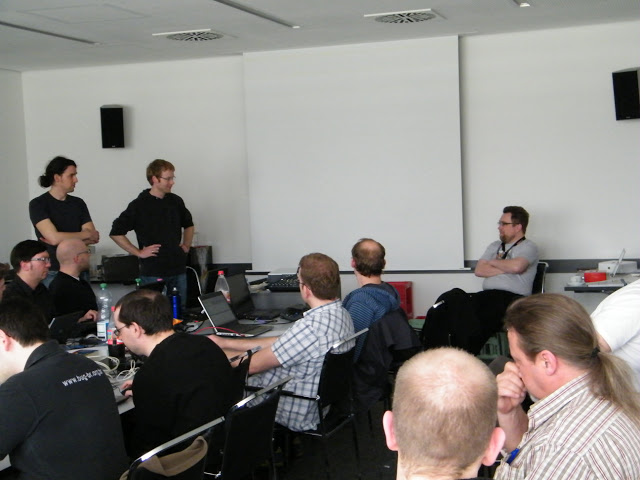
There've been a few talks in this casual atmosphere, starting with Colin Günther who already had to leave that Saturday afternoon. He described the progress of the WLAN system since R1/alpha1. Unfortunately there's not that much to report, as Colin was in the middle of his master thesis, which he'll start defending in May (good luck!). Since last BeGeistert Haiku gained 12 working FreeBSD drivers. Thanks to Alex Botero-Lowry (drax) there's now a tool called setwep which enables WEP encryption, which however, isn't considered to provide real security. WPA is therefore still the goal he'll be working on in the future. As is a GUI to detect and configure wireless networks. Special thanks went to Matt Madia who worked on integrating WLAN networking into the nightly builds and sorted out the licensing and installation of the different firmwares.
After that all attending Haiku developers had a chance to report on the progress made since R1/alpha1.
The biggest alpha2-blocker seems to be the missing IRQ routing which can lead to particularly WLAN drivers freezing the system. One idea that was briefly discussed, was to prevent these devices to share IRQs at all. (Looks like Michael Lotz started work on that during the Code Sprint, see r36225.)
Stephan's success with the WebKit and WebPositive is plain to see for everone with a current Haiku and Web+ build.
Ingo worked mostly on the kernel to remove locks that slowed Haiku down unnecessarily and on the vm caching. While Haiku and its BFS filesystem are still behind the highly optimized Linux components, the improvements have been quite substantial. Sponsored by the Haiku Code Drive he'll soon embark on extending Haiku's POSIX compatibility and, if it falls in that timeframe, coordinate the R1/alpha2 release.
Besides other smaller things, Oliver looked into POSIX integration of ICU with regard future localization efforts.
Michael implemented the idea of "anyboot", which simplifies installation by providing a single image that can be burned on CD or written to a USB stick.
Adrien kept working on the LocaleKit and managed to keep on top of things with regard to the massive amounts of localization files produced by the fine translators working with the HTA. Further improvements are expected in the summer, when he'll spend two Haiku Code Drive sponsored months working full time on that.
Clemens' main focus was and is on ACPI for power management etc. Maybe he'll also have a look at that IRQ routing problem.
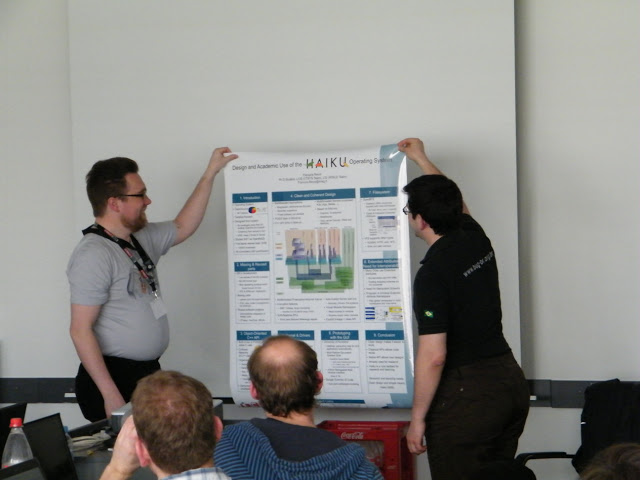
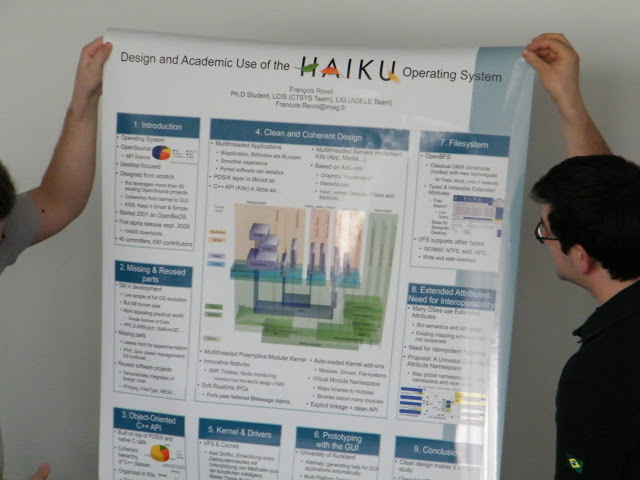
If in the past few months you haven't heard that much from François Revol - who was part of the usual French delegation together with Adrien, Olivier Coursière, Jerome Duval and Michaela - that's because, like Colin, he's focusing on his academic career at the moment. That's why he isn't at the Code Sprint this time either. However, he'll be presenting Haiku at the respected Eurosys conference in Paris. In the future he plans to ease the use of extended attributes between different platforms.
Another BeGeistert veteran also made an appearance: Ithamar Adema, the "Cola Coder". He brought a bunch of code with him, which has been committed to Haiku's SVN by now. It's all about printing, enabling three big features: using printers over the network via CUPS, distinguishing an using several printers connected over USB and printing postscript on all kinds of printers using Ghostscript.
And that is just for starters. We'll see much more of Ithamar's code hitting the SVN in the future. All the things that have been developed especially for Zeta are to be adapted and improved to become part of Haiku.
That's because Ithamar is paid by a company planning to bring a Haiku compatible operating system to the market. All operating system relevant development is to be done in the official Haiku SVN repository; there's nothing like a fork planned. This operating system is also not supposed to be the base of that company's commercial interest. It's all still quite unofficial and Ithamar wasn't free to reveal too much detail, but it sounds like the money is to be made with specialized applications and niche products. The name of that company: yellowTab.
The Sunday saw two more talks. First Niels Reedijk's "Haiku Has No Future", which he first gave at the last FOSDEM.
Later Jan presented a CD burning project that is based on Zeta's yab application JABA. It consists of a C++ library that any application can use as an interface to the cdrecord backend and a Tracker add-on to quickly select and burn some files. It's not yet clear if there'll also be a stand-alone tool or if the yab application will be updated.
This BeGeistert had something new to offer its participants: an optional "Workshop Monday". Many who joined the workshop held at BeGeistert 021 expressed interest in having a whole additional workshop day after the regular BeGeistert weekend. So, this time people could book the Monday to enjoy a hands-on lecture on programming given by Stephan Aßmus. Unfortunately, it turned out only two guys took up that offer: Finn and me!
A shame really, as picking a core dev's brain for about 5 hours is easily worth the 75 EUR. Considering I have only slowly picked up programming last December, others could have profited much more than me. Stippi showed us how to implement several design patterns like notification via listeners, reference counting and actions. I admit, much of what Stephan showed was a bit above my head. But still, I think I've learned quite a bit and am fascinated how elegantly one can code with C++. Plus, after all, I still have Stippi's code to come back to once I'm ready for his code-fu.
Thanks again, Stippi, for taking the time. Hopefully next time, when there'll again be a Workshop Monday, more people show up to learn from a seasoned Haiku developer.
BeGeistert was once more a success and everyone seemed to have enjoyed it. Missed were our Italian friends who somehow missed the date this time and couldn't arrange reasonably priced traveling. The date for BeGeistert 023 isn't yet fixed, but should again be in October. Hope to see you all there!
 |
 |
 |
 |
 |
- Details
- Written by: admin
- Category: FOSDEM
- Hits: 5642
FOSDEM 2016 - January 30 and 31, 2016 Bruessel (Bruxelles)
Article by mmu_man - 01 February 2016 - Haiku-OS.org
It's been some years since I last attended FOSDEM, and I kinda missed it. I was eager to participate again, yet a bit frightened at the perspective of having to run or miss so many interesting talks happening in parallel as always. Nevertheless it was comforting to know Olivier was here as well, and we attended different sessions.
After the opening session, the first troll^Wtalk was about systemd, or rather mostly about the DNSSEC implementation in systemd, and helped get into the mood.
I also had 3 accepted talks so of course slides to prepare up to the last minute. But that was the occasion to reach different audiences since they all were in a different devroom.
One was about our package management system, which I think could inspire some GNU/Linux distros (although I recall some obscure distros which actually also had this idea of mounting package contents virtually some years ago). Another one detailed the various toolkits ported (or not) to Haiku that people can code with. And the last one was a kind of "thank you BSD for all you gave to us".
For each talk I had quite a bit of people, and several questions at the end, so I suppose at least some of them were interested enough to consider testing Haiku. I'm not sure we'll see a difference in the download stats, but who knows.
Not having a booth (just because I missed the deadline) actually gave me the time to see quite a lot of other interesting talks, some related to the subject I discussed in mine regarding Haiku.
There was a session about GUIX, a Scheme-based functional package manager, which has some similarities with our own solution (like, their packages are immutable).
I missed part of the talk about FreeBSD graphics drivers, but arrived just in time to see mentioned "linuxkpi" which is their own version of "let's emulate someone else's kernel to run their drivers", which we could probably have a look at for Haiku.
Another interesting talk was one about standardizing boot on armv7 U-Boot, which of course was only about Linux, at least until I raised the question of other platforms. Basically they want to reuse the SYSLINUX config file syntax to help U-Boot propose a boot menu instead of having to type in commands with addresses in hexadecimal and other non-userfriendly stuff. I'll definitely need to keep an eye on that and propose things we need (like passing framebuffer configuration).
There was a talk about the VirtualBox Guest Additions and how to package it better in the future, as most distributions now ship with outdated versions, and having to install the latest ones from an ISO image could conflicts with those, and is not the best user experience.
I missed the talk about MIPS, but I suppose I have enough targets to look at for the time being anyway. I was interested in learning more about LLVM as well, but I guess I'll wait for the rerun. I won't know "The State of OpenJDK", apart that it currently crashes in the NetBeans install script on Haiku at the moment. The "How to design a Linux kernel API" speech was probably funny, I'll put it first on my watch-list!
There was a ReactOS booth along with the usual distro ones, so I passed by to thank them for representing alternative systems. In the other stands we had Perl, with an almost life-sized replica of their mascot, and they were selling Perl-branded wine. We also had one for Mozilla of course, which I didn't have the time to stop by for some trolling. There was even some people from Google giving information on the Summer of Code and Google Code-In projects, so hopefully we'll get even more interested students next time.
In the AW building were located yet some other stands, like one showing off the Minnowboard, and the Coreboot / Flashrom booth. Which reminds me I still have to finish my Flashrom port. I wanted to attend the KiCAD talk (we would need to get wxWidgets to port it btw), but the room was full and the queue extended to the bottom of the stairs at least.
At the LibreOffice booth we discussed the Haiku port again, hopefully someone will take the time to finish that. The taker might want to look at the record of the "Visual Class Library" talk that was given this year.
I also discussed hardware specifications with some FSFE fellows, and several other topics.
As I had to leave for my train, I left Olivier and missed the closing talk, I wonder if everyone jumped for the FOSDEM dance. I can't believe it's already finished.
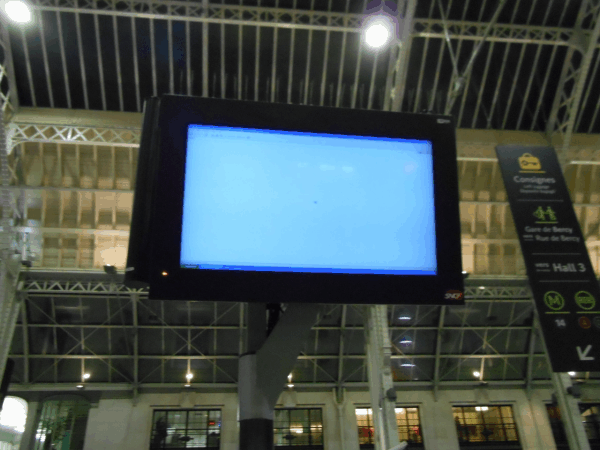
Interestingly, arriving at the Gare de Lyon I was greeted with one of the displays rebooting. The BIOS was too fast to get it on pic, but I got Windows starting up the desktop :D
Once again, this edition of FOSDEM was dense and interesting, and hopefully will bring us some more contributors! In less than two months I'll be at the Haiku booth for the JDLL in Lyon. As I'm not sure there will be anything more than the security track organized for RMLL this year, I'll be more than ever looking forward to the next FOSDEM.
- Details
- Written by: admin
- Category: FOSDEM
- Hits: 5796
FOSDEM 2010 - (Bruxelles)
Article by aldeck - 08 February 2010 - Haiku-OS.org
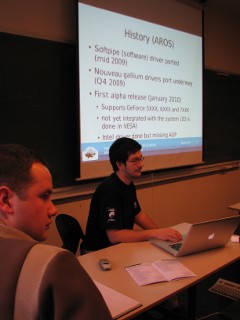
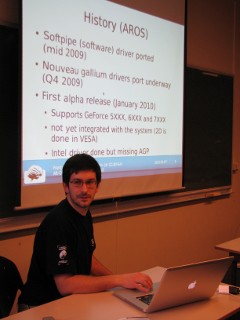
Just came back from FOSDEM 2010, i don't have much to say, since it was quite a flash journey for me, i left home Sunday at 7:30AM and got back at 7:30PM. I originally planned to go on both days but this year Haiku didn't have its own stand, instead Haiku was present Sunday in the Alt-OS (ie: not Linux nor BSD) DevRoom in the form of several talks by François Revol, Olivier Coursière and Niels Reedijk. The Alt-OS DevRoom was a (~50 people capacity) class room, that François entirely managed and organized, he invited other projects to give talks and scheduled the talks.
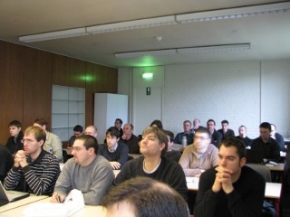
Unfortunately, i arrived a few minutes after Olivier started his "Introducing Haiku" talk, and the room was so packed that i couldn't even get in the room (for safety reasons). This is what i was welcomed with" :)
When i managed to enter, for the next talk, there were still no seats available and stood up like ~30 other people. I eventually managed to seat next to the Haiku guys (Jerôme Duval joined us in the afternoon).
Most of the talks were quite low level for me, but very interesting nonetheless. The room was full most of the time but not as packed (with people standing up) as in the morning. Olivier and i had our laptops on our tables with Haiku running, and when possible, between talks, we had a few quick chats with interested people. I had to leave very quickly right after Niels talk which i'd like to note, was a very original and inspiring talk about project goals, the notion of "future" and how it relates to Haiku (i hope i got it right Niels :) what about publishing a text version?).
Sorry for such a brief report, i mostly wanted to publish some pictures as i often regret not doing so, i'm sure François, Niels and Olivier will have more to say :)
Thanks for reading, and lets all thank François for organizing Haiku's presence again this year.
Here are the pictures, i'm sorry i didn't catch everyone (some pictures were too blurry to publish), will do better next time.
(BTW i'm not sure what is the proper way to attach images in blog posts) Full size images here. (Under a cc-by license)